Analysis / Computation
Where does AI scaling hit physical constraints first?
State of Compute Infrastructure — 2026 H1
Compute infrastructure is becoming a physical bottleneck: chips, memory, power, and data centers now define how far autonomy can scale.
Current state
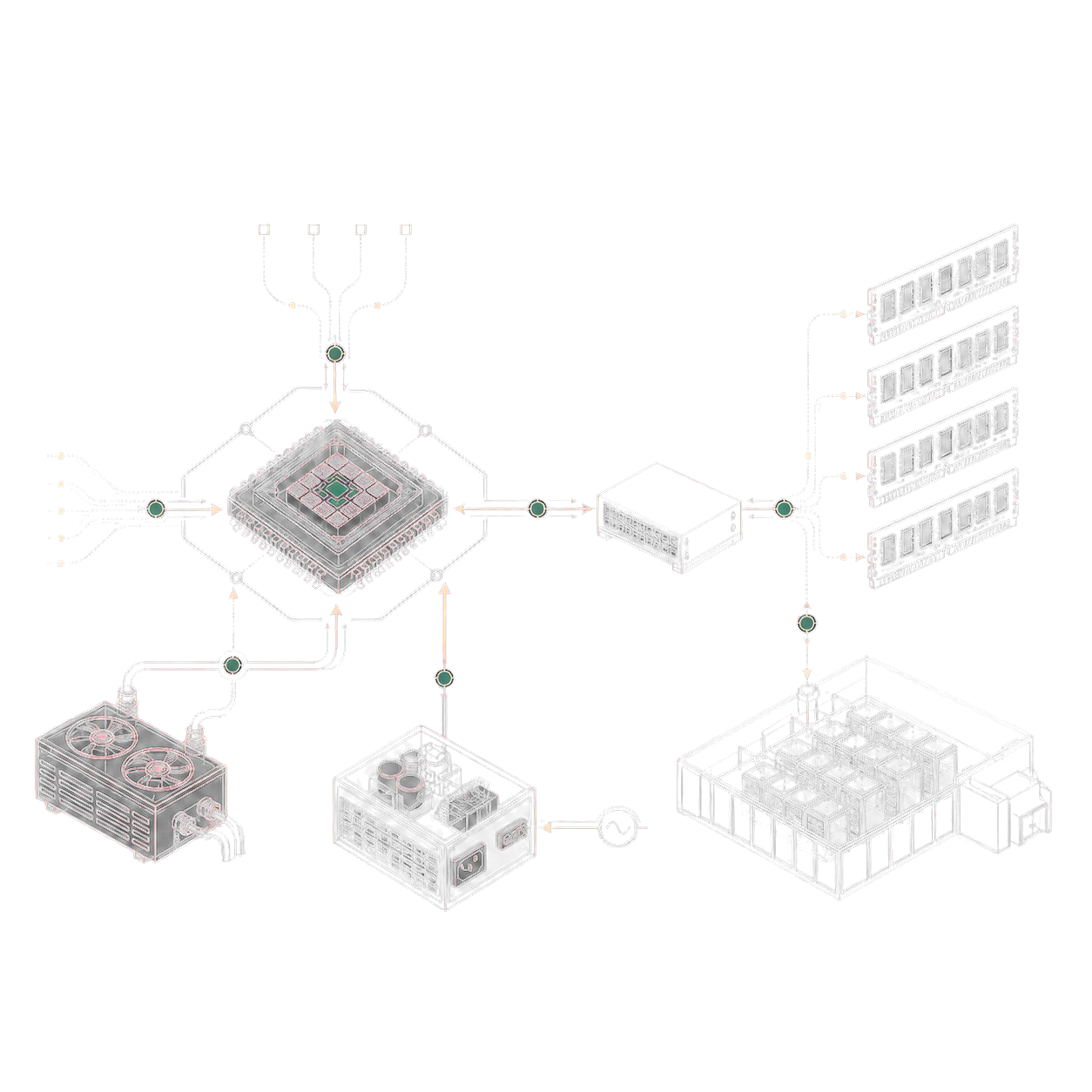
Compute is no longer an abstract software resource. Large-scale training and inference now depend on a physical stack: accelerators, memory bandwidth, networking, data centers, grid access, cooling systems, and capital allocation. The limiting factors are increasingly physical, financial, and geographic.
The useful question is not only whether models improve. It is whether the infrastructure around them can scale without hitting energy, supply chain, procurement, geography, or deployment constraints before capability can be used. Capability now depends on where capacity can actually be deployed.
What changed
The center of gravity moved from isolated model capability to system capacity. Data centers now behave more like industrial assets: they need land, power, water, interconnection queues, cooling systems, and long procurement cycles. Energy limits deployment, so grid interconnection, dedicated power deals, and cooling constraints increasingly shape where compute can be built and who can use it.
Capital decides who can reserve supply, policy determines which actors can access advanced hardware, and hardware availability increasingly shapes platform dependency. This makes compute infrastructure a cross-pillar system: energy, capital, and policy now determine how much intelligence can be deployed, by whom, and under which constraints.
Constraints
Hardware supply
Accelerator supply and advanced packaging remain major bottlenecks for frontier training and high-volume inference.
Memory and interconnects
Memory bandwidth and interconnects increasingly shape model economics, utilization, and deployment efficiency.
Power access
Data center power access is becoming a limiting factor for deployment, especially where interconnection queues are long.
Concentration risk
Compute concentration creates platform dependency, pricing power, access risk, and strategic vulnerability.
Impacts
For institutions
AI strategy becomes infrastructure strategy. Procurement, cloud dependency, energy access, and regional availability matter as much as model selection.
For builders
Performance work shifts toward efficient inference, memory-aware systems, scheduling, deployment topology, and software that extracts more value from constrained hardware.
For regulators
Access controls, industrial policy, grid planning, and supply chain resilience become central to compute governance.
For markets
Hardware allocation, power contracts, and data center capacity become signals of durable AI advantage, not just operational spending.
What to watch
Dedicated power deals
Long-term energy procurement and site-specific power access will show which operators can scale deployment.
Hardware allocation
Accelerator supply, advanced packaging capacity, and cloud reservation patterns will reveal where frontier capacity concentrates.